
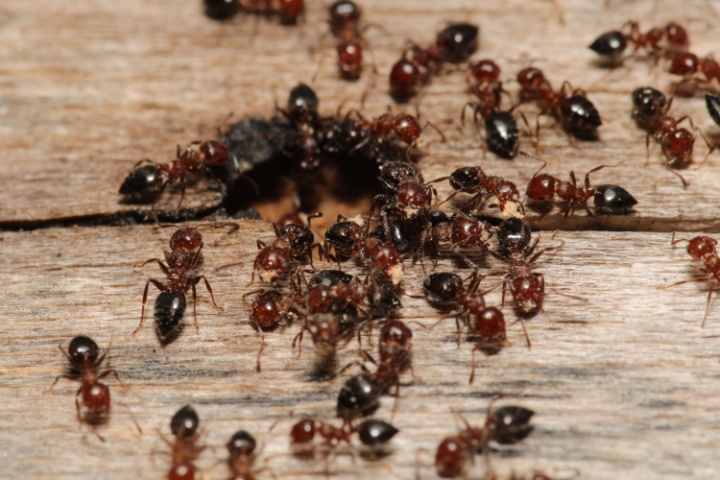
If ants have suddenly appeared in your Menomonee Falls home—trailing across the kitchen counter, circling the bathroom sink, or marching along the baseboards in a room you thought was sealed—the timing is not random. A colony near your home has sent out foragers in response to a specific environmental trigger, and your house is where they found what they were looking for. In southeastern Wisconsin, those triggers follow a predictable pattern tied to the seasons, and understanding what is driving the activity helps explain why it started and what it takes to stop it with professional ant control.
The Direct Answer
Ants are in your home right now because a colony living in the soil near your foundation, under your driveway, or inside moisture-damaged wood has identified your home as a source of food, water, or shelter. A scout ant found the resource, laid a pheromone trail back to the colony, and recruited hundreds of workers to follow the same path. That chemical highway is why the trail appeared seemingly overnight and why it re-forms even after you wipe it away.
What Triggers the Surge by Season
Ant activity inside Menomonee Falls homes spikes for different reasons depending on the time of year:
Spring (March – May): This is the most common time for homeowners to notice the first ant activity of the year. As soil temperatures rise above 50°F, colonies that have been dormant or semi-dormant through winter enter their expansion phase. More workers hatch. Foraging range expands. Scouts begin exploring farther from the nest—and your home’s foundation is right there.
Carpenter ant swarmers—the large, winged reproductives that indicate a mature, established colony—often emerge on warm spring days in April and May. Finding winged carpenter ants inside the home is a significant signal. It means a colony has been established nearby (or inside the structure) long enough to reach reproductive maturity—typically three to five years.
Summer (June – August): Ant colonies are at their largest and most active during summer. Foraging trails are heaviest. Indoor activity is most persistent. In southeastern Wisconsin’s humid summers, ants are seeking both food and moisture inside homes—kitchen sinks, bathroom faucets, dishwashers, and pet bowls are all targets. Pavement ants push soil mounds through cracks in driveways and walkways. Odorous house ants send dense trails along baseboards. Carpenter ants forage at night and may be seen moving through kitchens and bathrooms after dark.
Fall (September – October): Ant activity often intensifies briefly in early fall as colonies prepare for winter. Foragers become more aggressive about securing food before cold weather shuts down outdoor activity. Some ant species also shift their nesting behavior in fall, moving deeper into soil or into protected interior spaces—which can increase indoor encounters.
Rain events: Heavy rainfall at any time during the active season can trigger a sudden spike in indoor ant activity. Water saturates the soil, floods shallow nest tunnels, and forces colonies to evacuate. When the nest is next to your foundation, the most convenient escape route is into your home. This displacement pattern is one of the most common triggers for the overnight ant trails that catch homeowners off guard.
Which Ants Are You Seeing?
The species matters because different ants require different treatment:
- Small, dark ants trailing in lines along baseboards and counters: Most likely odorous house ants or pavement ants. These are the classic “kitchen ants” that Menomonee Falls homeowners deal with most frequently. They form colonies in moist soil near foundations and under hardscaping, and they send foragers inside through cracks, expansion joints, and gaps around utility penetrations.
- Large, dark ants—especially in spring or at night: Possibly carpenter ants. Carpenter ants are significantly larger than other common species, typically black or dark brown, and are most active after dark. If you are seeing large ants indoors accompanied by small piles of sawdust-like frass near wood trim, window frames, or door frames, carpenter ant activity should be investigated promptly. This species excavates galleries inside moisture-damaged wood and can cause structural damage over time.
- Very small ants swarming on sidewalks or driveways: Likely pavement ants. They nest under concrete and hardscaping and are commonly seen pushing small soil mounds through expansion joints and cracks.
What You Can Do Right Now
- Wipe down the trail with soapy water to break the pheromone signal
- Identify and eliminate the food or moisture source the ants are targeting
- Seal the specific entry point if you can find it
- Do NOT spray the trail with a repellent product—this scatters the colony and can cause it to split into new nesting sites
When to Call a Professional
If ants return after you clean the trail and remove the attractant, the colony is close enough to your home that foragers will keep finding new routes inside. At that point, professional treatment using non-repellent products that spread through the colony and reach the queen is the only approach that delivers lasting elimination.
Nexus Pest Solutions has been solving ant problems across southeastern Wisconsin for close to 30 years. The team identifies the species, locates colony activity, and applies targeted treatment designed for the specific ant dynamics this climate produces—from pavement ants in summer to carpenter ants in structural wood.
If ants have taken over your Menomonee Falls home, contact Nexus Pest Solutions for a free consultation and 58-Point Pest Analysis.